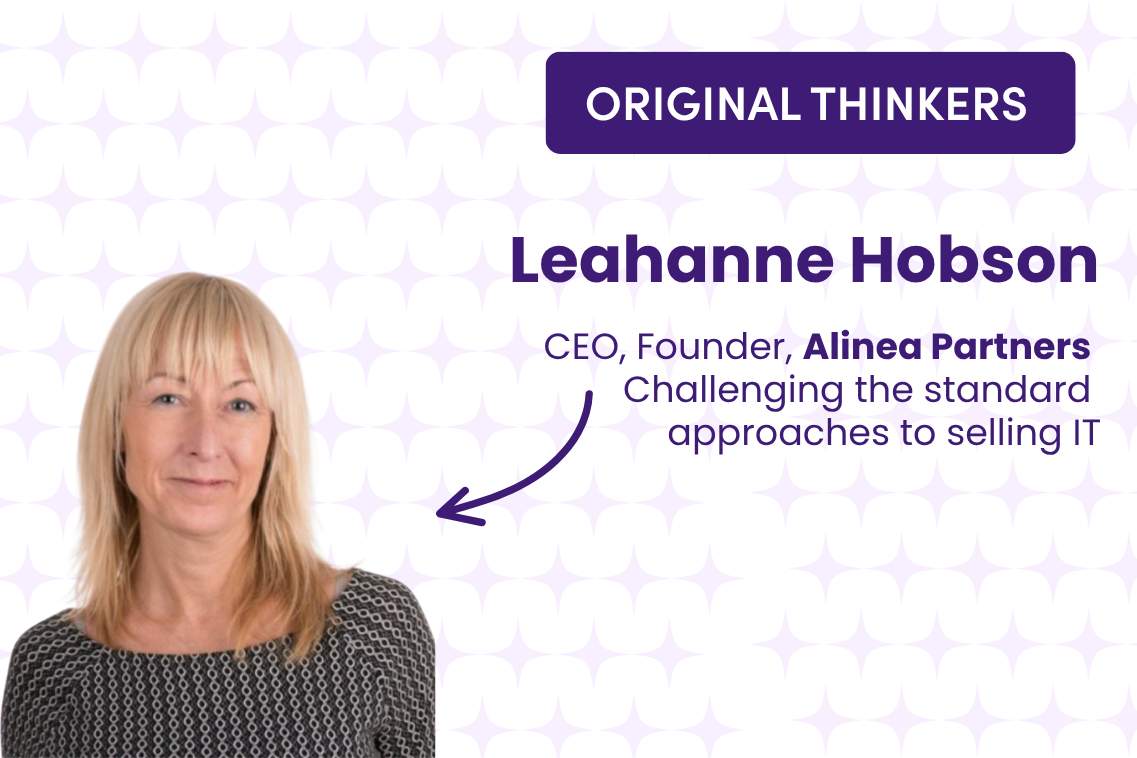
She landed in Vienna sight unseen, with no German, no job, no plan beyond accompanying her partner on a work posting and a hunch that something would turn up.
Something did.
Within about six weeks, Leahanne Hobson was consulting for the United Nations, specifically UNIDO, the arm that works on development for women. That took her into the room at the fourth World Conference for Women, watching Hillary Clinton speak from the stage, a Jordanian princess alongside her.
An American who’d landed in Austria on instinct, suddenly at the centre of things. “A pinch-me moment,” as she puts it. Then someone mentioned IBM was looking for a native English speaker to work across Central and Eastern Europe. She walked in and got the job the same day. Around the same time, her partner went back to the States.
She stayed.
Thirty-odd years later, she’s still in Vienna. IBM led to Lucent Technologies, then Avaya, where she spent the best part of a decade covering EMEA, some of Asia, and, as she tells it, living in “a plane, a hotel or a conference room.” Fed up with that life, she left to start her own company, Alinea Partners.
A global channel consultancy, Alinea Partners helps technology brands and their clients do exactly what she now urges on everyone: move from selling low-margin products to more profitable solutions and repeatable services. Its work spans portfolio and offer development, channel programmes, and customer experience assessments. Canalys has named the firm among its top global channel consultants.
Such is their reputation; after many years of working closely with Alinea Partners, Microsoft came knocking two years ago asking them to train end users on Copilot. Whilst training wasn’t their core offering, she said yes for one reason: the intelligence it would give them about what people actually doing with the technology, which they could share with their [Microsoft Partner] clients. Alinea Partners has since trained over 30,000 end users on using Copilot and Copilot Agents.
For the last three decades, Leahanne has worked at the bleeding edge of technology, and for a large part been up close with how Microsoft Partners sell. Her advice to those resisting AI: it’ll come at a cost — your customer base.
She sat down with Juliet Stott for the first of a two-part conversation about the business underneath the technology (part one) and how to sell Copilot (part two).
Juliet Stott: You’ve built a whole idea around “the cost of doing nothing.” What actually causes the inertia?
Leahanne Hobson: It’s one of my favourite acronyms, CODN, and we’ve been using it seven or eight years now. It came about because the same thing keeps happening in this industry. Go back to e-commerce. Then cloud computing. Every time, the forward-thinking part of the market says, this isn’t a challenge, it’s an opportunity, and here’s how you change your go-to-market and your business model to take advantage of it.
And every time you get three groups. The ones who say, we love this. The ones who say, I don’t believe it, what I’ve always done works fine, but I’ll do a little. And the ones who say, let’s wait and see.
Now we’ve got AI. Same three camps, on steroids.
So, if you’re running an MSP, and you’re not building the business case for what AI could earn you, you should sit down with your P&L and understand the cost of not doing it. And the cost of doing nothing today?
Short term it’s your revenue or profit. Long term, it is your customer base.
Because if you’re not there to coach your customers through AI, what it means, how to build it into their organisation so they get valuable outcomes from it, they’ll go to somebody who will. Opportunities for net new plays right now are fabulous.
“The cost of doing nothing today is your customer base.”
Juliet Stott: You say many Microsoft Partners are still just reselling licences, but that’s not enough to build a business on. What do you mean by that?
Leahanne Hobson: Just selling licences is a trap. Even with the margin uplifts coming in the new fiscal year, you’re still not getting much more than 15% on a licence, often less. Hardware and software margins are diminishing. So, if you’re only going to sell licences, you have to sell at such a volume that the numbers make sense. And you cannot compete on that with the Distis or telcos of this world. They do the volume.
You have to get out of that space.
Other smaller partners only really make money on what they build around the licence. And the most profitable thing you can sell, is your own IP. Up to 75% margin. Until now that meant a bot, an agent, a bit of software that put a process into technology.
With AI it means something simpler: document the workflows you’re putting Copilot on top of, and the new workflows that emerge from using it. Do that and you’ve got a whole toolbox of processes to consult around.
But you can’t document what you don’t use. Most partners aren’t running this top to bottom in their own business. Customer zero is nowhere near where it should be and if you aren’t using it, you can’t sell it authentically.
“The most profitable thing you can sell is your own IP, up to 75% margin. But you can’t sell what you don’t use.”
Juliet Stott: Why is the move from selling technology to selling outcomes so hard for Microsoft Partners?
Leahanne Hobson: Honestly, it’s habit, and it runs deep. So many Microsoft Partners can’t sell technology without talking about technology to save their lives.
It’s ingrained in the tech business to lead with features and functions, to think innovation just means one step better than the last thing.
Security, compliance, AI: these are CEO conversations now. So that’s where we do the upskilling, teaching partners to understand what interests the CEO, not just the CIO, and to move across the aisle and have the outcome conversation.
Because the people buying today don’t really care what you’re selling. They care whether it works and whether it solves a problem they’ve got. If you only sell on the technology, you sound exactly like the company to your right and left. So, what does the buyer look at? The price. You’ve just taken yourself out of a competitive bid and into the lowest common denominator.
“So many Microsoft Partners can’t sell technology without talking about technology.”
If that shift sounds familiar, the next challenge is turning those outcomes into something buyers can actually see.
See how we help Microsoft Partners market their Copilot services.
Juliet Stott: How does a Microsoft Partner actually get under the skin of a customer to find those outcomes?
Leahanne Hobson: The most success I’ve seen is when a partner really digs into who their customers are, not just what they’ve sold them.
What industry are they in? Is it growing, or declining? Is it run by someone obsessed with customer experience, or building eco-friendly solutions? Have they just made big layoffs and have to do more with less? Are they struggling to hire? Are they in a heavily regulated industry, or one that’s being targeted by cyber criminals?
Once you know those things, you understand what makes them tick, and why. Then you can walk in and say, by the way, we can help you hit those goals using AI.
And here’s the nice part: you can ask Copilot to help you do it. It’s called social listening. It’ll tell you what a leadership team is saying in podcasts, in annual reports, in press interviews. If they’re talking about something publicly, I guarantee they’re being paid on it. So that’s what you need to move the needle on, and that’s what you should be discussing with them.
Juliet Stott: Per Werngren makes the case for specialising, narrowing your focus, finding something you can sell again and again. Do you agree with him?
Leahanne Hobson: I almost always agree with Per. And the thing to understand is that this isn’t really a technology conversation but a business one. It’s the discomfort of changing your financial model. Investing in services with products attached, instead of products with a bit of service bolted on. Something you can turn into a subscription.
That means an owner has to say: I’m going to stop chasing the next new client to do a one-off project with, at least in part, and start building a service people subscribe to and I can sell at scale. The catch is you probably charge less for one subscription than for one big project. So, there’s a balancing of the finances in real time, and that’s more than a mindset problem, it hits people in the P&L. That’s why owners resist it.
But the payoff is a business you can actually predict. Recurring revenue is what lets you grow, or maintain, or sell. It’s what an investor looks at. A pipeline of one-off projects isn’t.
And it’s like any business you keep going for the long term. You can’t strip all the value out. You have to reinvest in moving the needle forward, not just in more technology. A lot of us come from IT, so we think reinvestment means R&D, some new thing to build. The reality is we’re moving into a world of service-oriented process change. That’s where the money is.
Read our Original Thinkers interview with Per Werngren.
In part two: the 30,000-person Copilot rollout and what it revealed, the build/buy/partner decision on change management and agents, and why she’d stop spending co-op funding on “trash and trinkets.”
Leahanne Hobson is founder and CEO of Alinea Partners, a global channel consultancy that helps technology brands and their partners move from selling low-margin products to more profitable solutions and services. Originally from the US, she has lived in Austria for more than 30 years, following senior roles at IBM, Lucent Technologies and Avaya. Canalys has named Alinea Partners among its top global channel consultants. Connect with her on LinkedIn or at alinea-partners.com.
The Smartest Way to Invest Your Microsoft Co-op Funds
Download our latest ebook: The Smartest Way to Spend your Co-op Funds
Read other articles by Juliet Stott and connect with her on LinkedIn.


