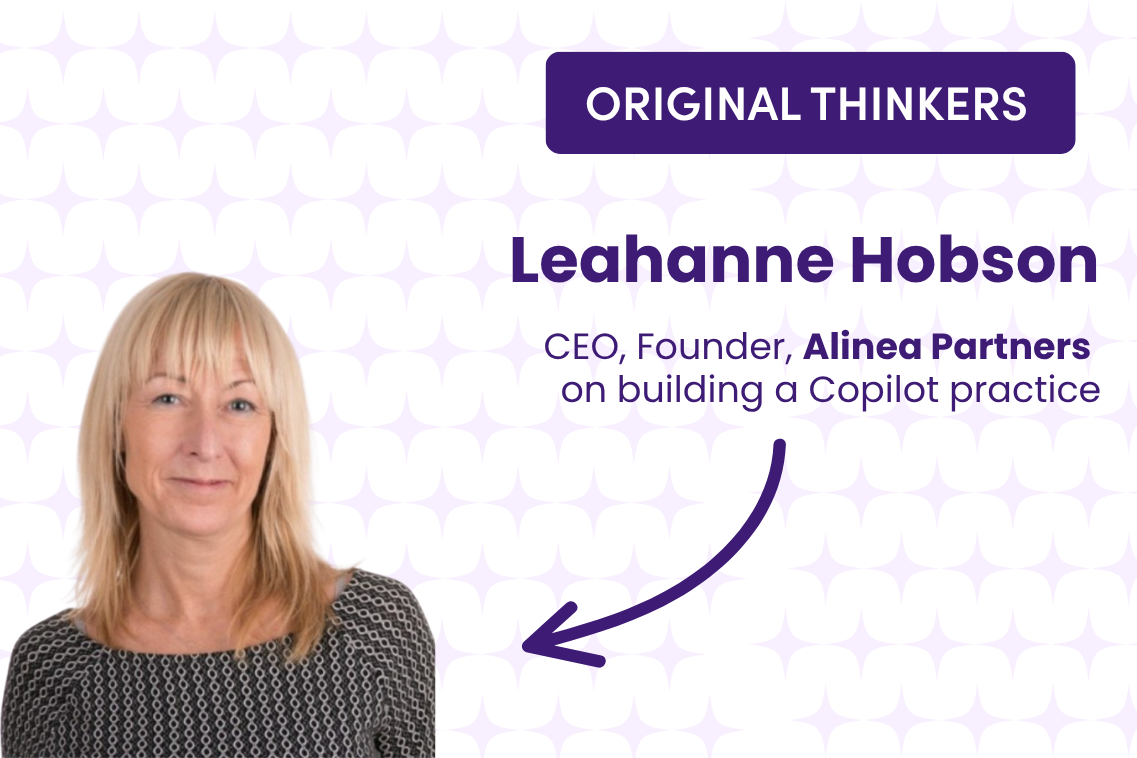
Two years ago, Microsoft asked Leahanne Hobson, from Alinea Partners, to do something her company almost never does: train end users. You see, Alinea usually works with those in the channel, not the people at the desks. Yet she said yes for one reason, the intelligence it would hand back to her partner clients about what people really do with Copilot.
Thirty thousand-plus users later, the headline finding is not the one most partners expect.
This isn’t an enterprise story. More than 40% of the people she trained were in small and mid-sized businesses. And they didn’t arrive asking about Teams, the tool every Microsoft bill of materials tells you to start with. They wanted PowerPoint. Then Excel.
And the ones saving hours a day weren’t the technologists, they were receptionists, project managers and HR managers, the people Copilot is handing a new skill to.
In part two of our Original Thinkers conversation, Leahanne maps what the rollout revealed, why adoption is the service most partners are still leaving on the table, and how to build and market a Copilot practice that earns well beyond just selling the licence.
Juliet Stott: You’ve trained more than 30,000 end users on Copilot. When you work primarily in channel, why take it on?
Leahanne Hobson: We don’t usually do end-user work. We work with channel partners, or directly with IT companies. But longterm client Microsoft asked, and I said yes because of what it would teach us. If we trained a couple of thousand people, we could feed that insight straight back to our channel partner clients: here’s what these users are actually thinking, here’s where they get stuck. That’s gold for a partner trying to build a practice.
It started with, how do you get going with Copilot?
Then new features came, so we’d run it again with the upgraded demos. Then we moved into agents. Two years on, we’ve trained a little over 30,000 people, in multiple languages, all over the world. It grew by itself. We started getting repeat participants, then bigger numbers, then organisations like the NHS asking if they could use our training videos. Yes, they’re free, go ahead (we and Microsoft agreed).
And one of the findings that surprised us: Copilot is not just an enterprise play. More than 40% were small and mid-sized businesses.
” Copilot is not just an enterprise play.”
Juliet Stott: What surprised you most about how people actually pick it up?
Leahanne Hobson: The first aha moment every single customer has is that Copilot isn’t like normal software. You’re used to buying something, getting an email, clicking a link, and there it is.
Copilot’s different.
It just starts to populate in the background. It builds over time, gets more intelligent as you feed it your preferences.
So, the very first question in every session is, where is everything? Because it keeps changing. It’s so fluid, Microsoft is moving fast, always making improvements. So, suddenly the icon’s a different colour, or it’s in three places, and the question asked is, do I get different functionality if I click on it somewhere else?
Every Microsoft bill of materials tells you to start with Teams, and that makes sense, it’s communicative, you get an instant transcript. But people don’t want Teams first. What we found, is they want PowerPoint. Can you build me a presentation on this topic? Can I do it in multiple languages? How can I change the images? Can you make it sound more like me?
Then Excel, and that’s the really interesting one. Many people only ever used Excel for list-keeping. When they realise they can suddenly analyse things without knowing a single formula, they get excited. I didn’t know Excel could do this. They do more, they produce more and better, and that’s where the ROI shows up. Someone says, I’m saving X hours a day, and I’m back to customer-facing work instead of a report I used to dread every week.
“People don’t want Teams first. They want PowerPoint. Then Excel.'”
Juliet Stott: Microsoft has moved to a pay-as-you-go consumption model for Cowork and agents. Some partners worry it’s come too early, that people haven’t got comfortable with the basics before they’re being metered. Has it?
Leahanne Hobson: Two things. First, they’re not the first to do this. Every other AI tool has charged for usage from day one. And Copilot chat is free. It always has been, and it stays free. So, people can still experiment without a bill.
Will the new model confuse or frustrate the channel, or slow things down? Probably. But only for the partners who haven’t moved their mindset.
If you’re still just selling licences, yes, you’re in trouble.
But if you see it and think, this is my opening to go in and coach my customers first, then it’s an opportunity. You help them work out which tool for which job. The basic Copilot here, Cowork or an agent there. Different tools in the toolbox for different occasions.
That’s a value-based service, and it isn’t one-and-done. You go back regularly. People will pay for that.
And there’s more attached to it. Just as you’d run a security assessment, you run a data-access assessment before Copilot goes anywhere near a customer’s content, deciding what it can and can’t reach. You charge for both. And security brings hardware and software you can sell alongside it. It’s all in how you position the offer.
“If you’re still just selling Copilot licences, you’re in trouble. The opportunity is to coach.”
Juliet Stott: So once someone’s had the taster session, how should a partner actually drive adoption, pilots, champions, the ADKAR route?
Leahanne Hobson: Let’s be clear about what my training was: how to get started. A 101, a 102. The real adoption work, getting it in, getting it piloted, getting it to spread and scale, that’s the channel partner’s job, not mine. We give them ideas for how they can build that service catalogue or how to get it delivered with a high customer sat level.
You have to do the right thing for the right kind of customer. Depending on size, scope and ambition. But here’s what I’ve seen work.
There are training companies, if you just need people up to speed fast, or you do it in-house.
There’s technology you can attach onto Copilot that prompts you at the right moments, gives you tests, walks you through prompting over a one-to-three-month onboarding.
Then you’ve got change management, which you build, buy or partner for. And on top of that, the bit people miss, you also have to know how to package it as a business, not just run the Microsoft spec. If you’re a smaller MSP, you might do that on a project basis with a partner to begin with.
Then agents. If you can’t build them yourself, there are companies that only build agents. They don’t want your licensing business, so you white-label them. One agent or ten, sell it through as your own.
And at the top of the stack, my favourite, what I call “customer delighters”. You can hire young, dynamic people who really know how to use Copilot, who’ll walk the floor for your bigger customers and be there on demand. Think of the former IT person who came running when you had a blue screen. Same energy, but for getting value out of AI.
Juliet Stott: Where does this go for the partners who get it right?
Leahanne Hobson: An ongoing education stream, for a start, tailored to big and small customers. For the smaller ones I’d automate it to take cost out while keeping the quality up; there are tons of videos, use Microsoft’s own, package them. Beyond that it’s consulting, assessments, agents, your own IP, the whole surround at higher profit levels by the way.
But the real prize is bigger than a service line.
We have no idea where we’ll be in three years. To be able to put this kind of capability into the hands of ordinary people in a business, not just the specialists, is phenomenal. The partners who understand that, who go in and coach the transition instead of shipping a licence and walking away, are the ones who’ll still have the customer at the end of it.
Juliet Stott: So what content should partners actually be producing to teach it rather than sell it?
Leahanne Hobson: When it comes to AI, I wouldn’t spend a euro on a branding exercise. We’re being hit with AI in the workplace everywhere we go, nobody is talking about anything else. So we don’t need advertising. What we need is to stop selling it and start teaching people how to use it. That’s the role of sales and marketing now.
And the content follows from that. It’s not, here’s Copilot, look at all the fancy things it can do. It’s real people using Copilot, for outcomes, driving their business.
There was an ad I saw that got it exactly right.
A man goes into the office and picks up this assistant who’s invisible to everybody except him. He’s riding around on his moped with it, going to customer meetings, asking it to brief him, and it’s telling him who’s going to be at the next one and what the agenda is.
The whole thing is a play on Harvey, the old James Stewart film where the man’s best friend is a six-foot invisible rabbit. It was fantastic, because it showed you what the experience of using it was actually like. It focused on, what do I get out of this?, instead of, hey, it’s here and it’s exciting!
“Stop selling Copilot and start teaching people how to use it. That’s the role of sales and marketing.”
Juliet Stott: And if you were designing that campaign for a partner tomorrow, what would it say?
Leahanne Hobson: I’d run it almost as a public service announcement, from marketing out to every customer. It opens with a question: are you using AI Copilot today, or are you Copilot curious?
Because if they’re curious, you’ve got several things to tell them straight away.
Did you know you can test Copilot chat without paying anything? Did you know we can come in and help you expand your vision for AI further? Are you worried, because you are a user, about the new announcements around Cowork?
Produce content that shows you understand what’s happening to them and position yourself as the coach who can guide them through it. This is a very different message from here’s Copilot, would you like to buy it?
That is exactly the kind of shift our Copilot marketing service is built around: finding the problem you solve best, turning it into a clear offer and supporting it with service pages, case studies and campaign content.
See how we help Microsoft Partners market their Copilot services.
Juliet Stott: All this coaching and teaching costs money to produce. Partners have Microsoft Co-op funding for exactly that, and a lot of it goes unspent. Why?
Leahanne Hobson: OK, but let me start with what I’d stop spending it on. When I was at Lucent Technologies, one of my first meetings with the sales team, I got up on stage and announced we were no longer going to be in the merchandising business. We were no longer going to spend our Co-op on, I’ll use the British term, “trash and trinkets”. I’d extend it now to flights and event attendance and all the rest of it.
On average, there are certain parts of the world, and certain types of company, that badly underutilise their Microsoft Co-op. It’s a tragedy. And it comes from failure to plan, which is another way of saying it drops straight into the cost of doing nothing bucket [read part one of our conversation with Leahanne]. If there’s no plan for what the company is focused on, then everything is ad hoc… new announcement, quick, we need an activity.
Step back and ask, what are we trying to achieve? What’s coming out? And how do we package it together to make impactful announcement?
So if you’re a marketer walking into a partner business, day one of your first hundred days, go and find out how many Co-op marketing dollars you’re sitting on.
Don’t tell me you don’t have a budget if you haven’t looked at that.
Once you’ve found it, invest it in a content strategy for the year. There’s no need to do that in house. It’s something other people who write well for a living can produce at scale.
“Underutilised Microsoft Co-op is a tragedy. It comes from failure to plan, which is another way of saying it falls into the cost of doing nothing bucket.”
Leahanne Hobson is founder and CEO of Alinea Partners, a global channel consultancy that helps technology brands and their partners move from selling low-margin products to more profitable solutions and services. Originally from the US, she has lived in Austria for more than 30 years, following senior roles at IBM, Lucent Technologies and Avaya. Canalys has named Alinea Partners among its top global channel consultants. Connect with her on LinkedIn.
Bright Star’s “The Smartest Way to Invest Your Microsoft Co-op Funds” ebook covers where to find your Co-op, what Microsoft will approve it for, and how to invest it on content that’ll still be working for you next year.


