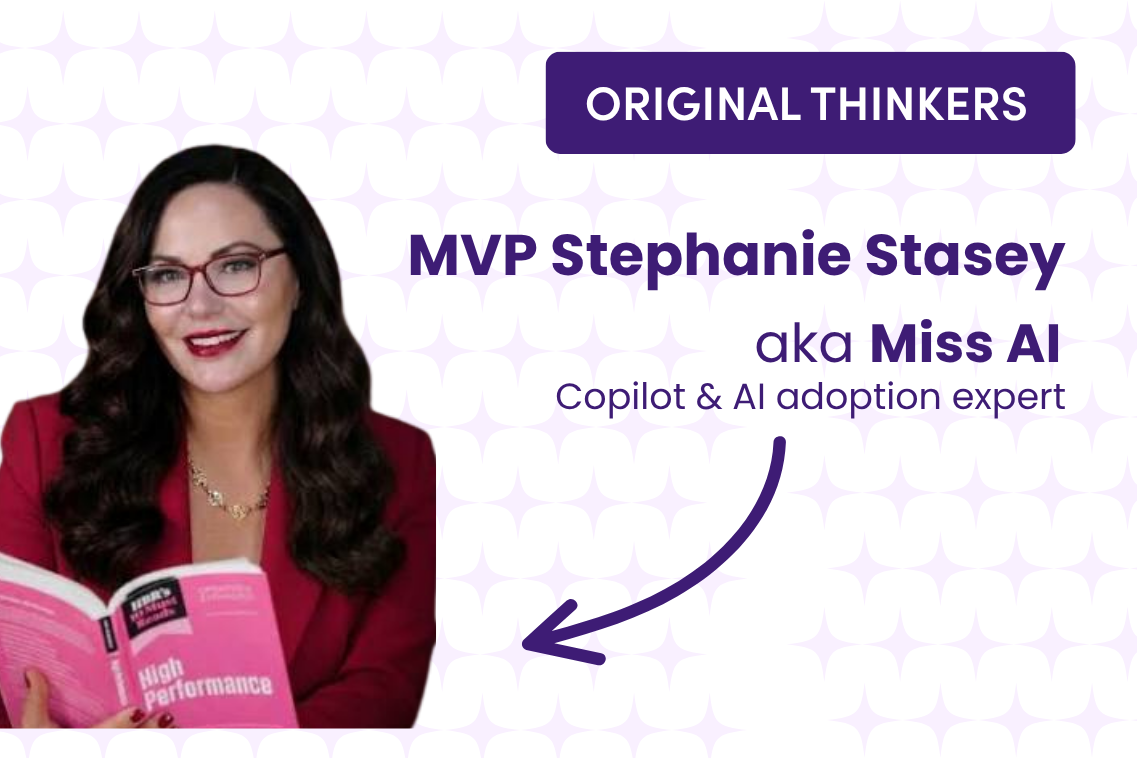
Early in her career, Stephanie Stasey arrived at a large tech conference in Amsterdam and was asked why she hadn’t come sooner. The organisers had assumed a young woman could only be there to hand out the badges.
She was there to speak.
Moments like that shaped a lot of what came next. Stephanie has spent more than 15 years leading AI, automation, digital transformation and change programmes for some of the UK’s largest organisations.
As a manager at Microsoft, she worked with NHS England, Microsoft’s largest customer, on NHS.net and the NHS App, alongside its Copilot, Azure and low-code programmes. In 2025 she left to found Miss AI, with the aim of helping a million non-technical leaders and managers adopt agentic AI.
Her speciality is the part of AI most organisations skip: getting people to use it well.
So far, she has trained more than 14,000 people in Copilot, is PROSCI certified and has supported health, FMCG, automotive and technology organisations through automation and agentic change.
She guest lectures at UCL Computer Science and Cranfield School of Management, is regularly ranked among Europe’s top AI and automation voices and has just been named a Microsoft MVP.
She’ll tell you she refused to do anything extra to earn that last one. “If I look at the best MVPs I know, they’re doing this because they were always doing it. They’re not chasing the badge.”
Alongside the day job, she runs one of the fastest-growing AI communities in the country. In November 2023, while still at Microsoft, Stephanie and fellow community organiser Lewis Baybutt set up BletchleyAI User Group.
Bletchley is the town they grew up in and around, where an estimated three quarters of the wartime codebreakers were women. They had one aim: nobody should walk into one of their rooms feeling they had to prove they belonged there.
Three years on, BletchleyAI User Group is the biggest tech community in Milton Keynes. It is now one of seven UK AI User Groups, with around 7,000 members across Bletchley, London, Birmingham, Manchester, Liverpool, Newcastle and, launching soon, Oxford.
Thirty-five volunteers run them. Chanel, Network Rail and Volkswagen Financial Services are among the end-user organisations that turn up to share what they’re doing in this space.
Her view on Microsoft Partners selling in Copilot? Well, she’s pretty blunt. Selling customers the licence and praying they’ll use them won’t get them where they want to be.
She sat down with Juliet Stott to talk about what the UK AI User Groups are for and how you can get involved, then on to why so many Copilot rollouts stall and where you should focus your Microsoft Partner practice next.
Juliet Stott: What are the UKAI User Groups set up to do?
Stephanie Stasey: Our mission is to empower everyone to use AI. And I mean everyone.
Bletchley is home. We didn’t have a tech community here, and we knew other people wished they had one rather than trekking into London. Given what happened at Bletchley Park, it felt vital that we had our own.
Bletchley’s history matters to us. Most of the codebreakers were women, and many would probably be described as neurodivergent today. The people who belong in tech have always been more varied than the faces you see in most partners now.
So, we built a community where nobody walks into the room feeling they have to prove they belong. You’ll see it in our posters. They reflect the communities we actually live in.
Rebecca from our group came to an event with me recently and said, “There’s another Black woman in the room. That normally only happens at your user group.”
Juliet Stott: Who are the groups for? Is this a Microsoft Partner community?
Stephanie Stasey: Not explicitly. About 80% of the attendees, and probably 80% of the sessions, are on the Microsoft stack, because most enterprises are using it, especially for end-user Copilot.
What I wanted was to widen participation in what we usually think of as the Microsoft community. When I worked in the public sector, these organisations were rarely in the room at events, and that felt like a miss. These practitioners are keen to share patterns and their thinking with each other.
So, we’ve had brands like Chanel turn up and talk, and Network Rail spoke recently. Volkswagen Financial Services support us and sponsor our events. We want everyone in the sector to come and share their story, whatever tech stack or model they’re using, and that includes Microsoft Partners.
Sometimes a partner and their customer co-present. One says, “This was my problem,” and the other says, “Let’s get into the technical detail of how we solved it.” I love that.
Juliet Stott: So how can Microsoft Partners get involved?
Stephanie Stasey: Unsurprisingly, I’m going to say sponsorship. We have annual sponsorship packages, and we’d love more sponsors.
What sponsorship won’t buy you is a speaking slot. We like to curate every session. And we don’t take submissions, as the people who submit tend to be the ones already on the speaking circuit. We’d rather have scouts out looking for the best learning in the sector. When they see someone brilliant, they fill out a form to nominate them, and the bar is incredibly high.
We’d also love more volunteers. We have 35 now, and lots of them work at partner companies. There are still a couple of slots on our national committee and locally, across a whole range of roles.
Juliet Stott: What do Microsoft Partners get from being in the room at one of your events?
Stephanie Stasey: You get access to customers you wouldn’t normally get near. You might be sat next to the CIO of a large end-user organisation, who asks you about something you mentioned in passing. Nobody’s pitching, so the conversations are real. You won’t get that in a partner-only community.
You’ll also hear first-hand what end users are struggling with. Public sector organisations, retailers and transport operators stand up and talk about their own AI projects, which tells you more about what your customers need than any sales meeting will.
And, if you’ve done great work with a customer, you can ask to tell that story together. We’ve had partners and customers co-present, with the customer explaining the problem and the partner getting into the technical detail of how they solved it. Being curated in on merit carries a lot more weight than a sponsored slot.
You’ll also learn from the people building the product. Lots of Microsoft employees run our groups as volunteers or come and speak, and often the most brilliant session is from a product team member or developer advocate.
Plus, you stay across the wider market. You have to go deep on the Microsoft stack, but someone who works on something else will come up and say, “Did you see this?” That’ keeps you informed in a way that’s much richer than just reading the news.
Then there’s the human side. The train line from Oxford and Cambridge into Bletchley is reopening, and when it does, you’ll find three or four attendees on the same train home, still talking.
Juliet Stott: As a Copilot and AI trainer, what are some of the biggest mistakes you’ve seen with rollouts?
Stephanie Stasey: The biggest is thinking you can buy a licence, hand it to somebody and you’re done. I see it in public, private and charity sector organisations alike.
That worked for the Office suite because most people had already used Word, Excel and PowerPoint. We pretend they have a deep understanding of the whole product, and many people never do, but they know enough to get on with their job.
Copilot doesn’t work like that. Give somebody a licence and they’ll try a prompt. It’ll be simplistic, they won’t like the result, and nobody will have explained chaining prompts to them or when to open a new chat. So, they rely on what they heard in the pub: another tool is better, use that. That’s how you get shadow AI.
In regulated industries that’s a nightmare. Samsung had product information leaked because staff shared it with an AI tool that wasn’t approved, and Samsung’s teams are typically very technical. GDPR, IP, the lot.
The other mistake is the big-bang training day. People get booked off for a day, shown 37 things on a Friday, and on Monday morning they have a notebook of 37 things they know they don’t know how to do.
Juliet Stott: What can Microsoft Partners learn from that?
Stephanie Stasey: That selling customers the licences and praying [they’ll use them] isn’t a strategy. If you’re helping them roll out Copilot, the adoption plan matters as much as the licence count.
Start with the basics nobody explains, like how to prompt, how to chain prompts and when to start a new chat. Small things like that make the difference between someone giving up in week one and someone sticking with it.
Make the case for staying inside Copilot. With a paid licence and Work IQ switched on, it has all of your context. You just need to know how to sweat it.
And when your customer’s adoption programme needs to be richer than a training day, bring in the people who do this for a living.
Juliet Stott: Some customers’ employees will push back on Copilot. Some fear it will take their jobs, and others worry about the environmental cost of AI. How can Microsoft Partners tackle that resistance?
Stephanie Stasey: I’ve not met many people that have said to me outright, “I don’t want AI.” What they want is to understand what it means for them.
On jobs, start with the work people don’t want to be doing. In the NHS there’s so much administrative burden AI can take away, and the result is time back for patient care. That’s the conversation to have. Show someone one thing that gives them back 15 minutes a week in their own role, and the fear starts to shift.
The environmental question comes up more often. People ask how they can square it. Do they plant trees? Is it going to get worse?
My question back is, why would you think it’ll get worse? Chinese models like Qwen and Kimi use something like 10% of the resources of the big American models. Then there are small language models, 13 billion parameters or fewer.
When you buy a car, you don’t ask what the fastest car in the world is. You ask what your functional needs are. The AI market hasn’t reached that point yet, and that’s where Microsoft Partners can help.
Ask what your customer needs to do, then which model fits it. You can select models inside Copilot. If you’re advising a call centre that only handles car insurance, they don’t need a model that knows everything.
And some of what we’re throwing large language models at should always have been automation. If a step is a yes or a no, it doesn’t need AI at all. As customers get more selective, AI becomes far more energy efficient.
Juliet Stott: There’s a lot of talk about sovereign AI. Should we worry that a new model will make Copilot redundant?
Stephanie Stasey: The UK is funding two frontier AI research labs, one run from UCL and one led by Oxford. People with PhDs in AI are asking whether large language models are even the right type of model, as well as how we build a frontier one of our own. It’s not unthinkable.
But if we do get new models, including sovereign ones, I think Copilot is the best place for them to live. That can happen now. With the right setup, you can host a model from anywhere in the world in Azure AI Foundry, customise it to some extent, add a responsible AI layer and run it within Copilot. There’s no reason you can’t bring your own model and serve it up in a tool we’ve already trained people to use.
People have had Word for decades, and they’re very happy with it. I’ve worked on Google’s business, and I’ve seen what happens when someone is handed a Google Sheet and can’t find the buttons. Moving people from something they know very well to something they don’t is a big total cost of ownership, especially when not all of the workforce wanted it.
The smartest thing you can do is go deep on the Microsoft stack and keep an awareness of the wider world, because in two years someone may pop up with a model that isn’t what we currently think of as the frontier.
Juliet Stott: Where should Microsoft Partners focus their efforts in this market?
Stephanie Stasey: You’ll already have specialisms. If you’ve existed for a while, you’ll lean heavily towards technologies where you have areas of brilliance. Keep going with that rather than feeling you have to reinvent yourself as the AI thing.
If you’re heavily security focused, a CISO has never wanted their hand held more. The threat landscape changes every time they fall asleep. They wake up thinking, “Please don’t say it’s all over. Please don’t say I missed my phone going off.” So double down on that, then work out where you can widen it. If you look after security and more of the M365 estate, you can help switch on things like Agent 365 and Purview.
Ask yourself: what are the adjacent things to what I already do that are relatively light and easy for us to own?
Juliet Stott: How can partners work with you?
Stephanie Stasey: We do Copilot skilling and adoption. If you have a customer exploring an adoption programme and you think it needs to be richer, reach out. I’m PROSCI certified, but I don’t think that alone necessarily solves the problem of where we are right now.
Ping me on LinkedIn. I’m very likely to respond the same day. There’s a booking form on our website too. We’ll talk about what you’re looking to achieve, where your customer is and what you might do together.
Expecting to sell the licences and pray isn’t going to help most mid-market and enterprise organisations achieve their outcomes. If you think I can work with you or alongside you, let me know.
Work with Stephanie Stasey
If a customer’s Copilot rollout needs more than a licence and a launch email, Stephanie works alongside partners to deliver skilling and adoption programmes. Message her on LinkedIn, where she usually replies the same day, or book through her website, Miss AI.
Join your nearest UKAI User Group
Whether you want to sponsor, volunteer, nominate a speaker or just turn up and find out who you’re sitting next to, start here: https://www.ukaiusers.co.uk/
Turn your Copilot work into proof that wins you new work
If you’re rolling out Copilot for customers, you already have the stories buyers want to hear: the problem you solved and what changed for the people involved.
Bright Star’s journalists will interview the people closest to the work and find the story they’ve stopped noticing. Then we’ll turn it into case studies, Customer Zero stories, expert articles and LinkedIn campaigns that help you win the next deal.
You can pay for it with your Microsoft Co-op funds.
It all starts with a no-obligation conversation.


