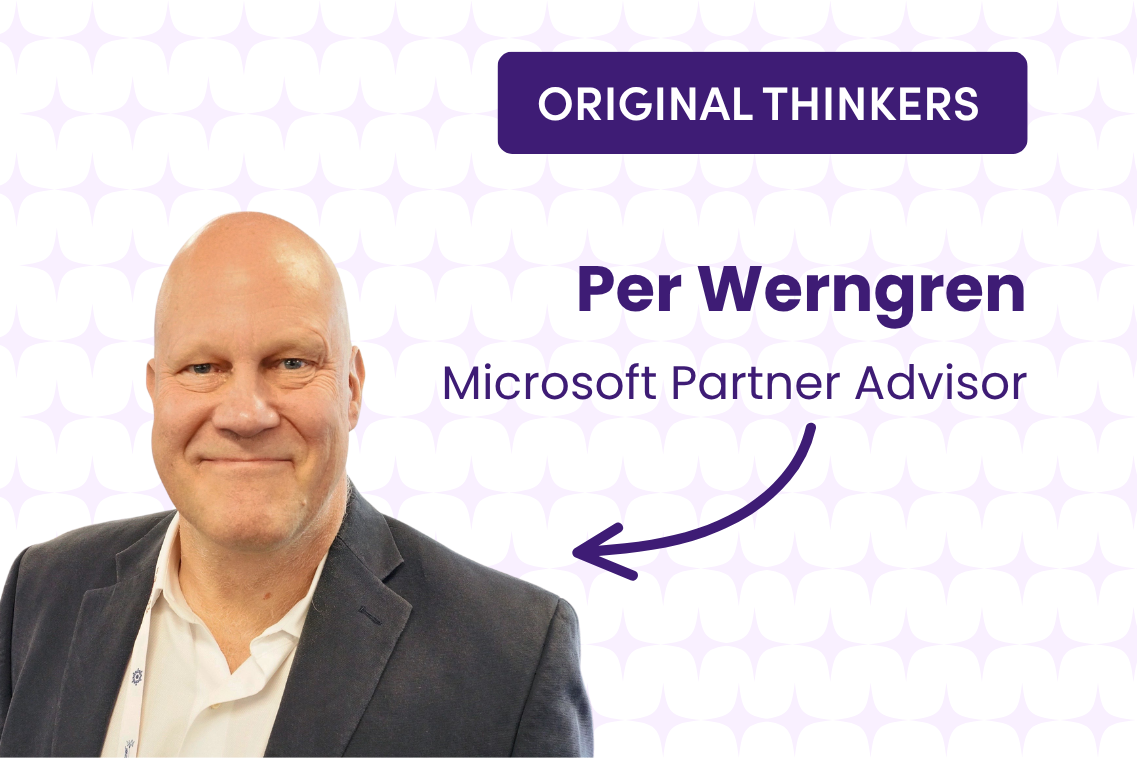
When Per Werngren decided to ditch Novell and go all in with Microsoft in the late 1990s, it was not a popular decision. Microsoft was unproven in the enterprise market, a consumer company playing catch-up in what he calls “a war of networks”. Some of his own people resigned over it.
The bet paid off.
His fascination with Microsoft however began much earlier, when his father brought home the first IBM PC running MS-DOS. Playing games on it got him hooked, and he never really stopped paying attention.
In the decades since, he has led the growth of the International Association of Microsoft Channel Partners (IAMCP) from four countries to 44, building a network whose members now do more than $10 billion of business with each other every year, serving five terms as its worldwide president along the way.
Traveling all over the globe opening up country chapters and motivating Microsoft local leadership and partners was hard work that created results, and as a side-effect made his extensive global network.
He has advised European and Indian Microsoft Partner companies setting up shop in the States. Now he is turning the tables, helping North American Microsoft Partners come to Europe. Just don’t call the region EMEA. To Werngren, the label is an insult: 120 countries lumped together as if they were a single market, when each has its own cultural identity and needs its own approach.
Some truths of expansion, though, are universal, regardless of your market: Specialise. Build a recurring revenue stream. Find partners on the ground. And start small.
He sat down with Juliet Stott to talk about his new service offering and the advice he’d give to Microsoft Partners looking to grow beyond their borders.
Juliet Stott: Let’s start at the beginning. How did you come to bet your business on Microsoft?
Per Werngren: I’ve been starting and running companies in the tech space my whole life. Some of them combined tech and finance. In the late 90s, I realised Microsoft was entering the corporate space, and the company I was leading at the time decided to ditch Novell, which was a very dominant player, and go all in with Microsoft.
It was controversial, because Microsoft was not proven in the enterprise space, playing catch-up from consumer market. We acquired a company that specialised in Novell and almost everyone quit when we transferred to a Microsoft environment. But their customers stayed.
Once we’d made that bet to go all-in, it became important to get to know Microsoft, and to find ways to do business closer to them. That’s what led me into building the IAMCP.
Juliet Stott: You went on to serve five terms as worldwide president of the IAMCP. What does the organisation do, and why does it matter to the partners it serves?
Per Werngren: The International Association of Microsoft Channel Partners is a business network where every Microsoft Partner is welcome to join. There are half a million Microsoft Partners in the world, and we want diversity: partners of different types, sizes, serving different customer segments. The more diversity, the more business opportunities our members get.
We run chapters in most of the states in the US, in several countries in Europe and some in Asia. When I left there were 44 countries; perhaps we’re up to 47 now. And it all comes down to partners meeting each other, learning what they can do for each other, and finding business opportunities together.
Juliet Stott: Should partners join with a mindset of competitive collaboration?
Per Werngren: Absolutely. Sometimes you have fierce competitors who share a drink together and discover they’re more collaborators than competitors. It might be that they serve different geographical markets, and that’s a way of partnering. But the bulk of what our members do together is when a partner doing one thing teams up with a partner doing something else.
What happens when people meet is that they build trust. I’ve seen it a few times: a competitor is really stuck with something, and in the middle of the night he phones that business owner, wakes him up and says, “I really need your best guy to sort this problem out.” That happens because they trust each other. They’re competitors, but they know that helping someone is good, because that karma will come back another day. And it really works.
Juliet Stott: Who owns the customer relationship in those scenarios?
Per Werngren: First of all, nobody owns the customer. That is lesson A. You serve at the pleasure of the customer.
The other thing is that you need to trust each other. If you trust each other, you will work it out. The margin on that deal is not what’s important. What’s important is that the lead partner in the first deal becomes the supporting partner in the next.
Giving back to each other, and finding customers together, matters more than the margin in any one deal.
Of course, every partner involved needs compensation, not just for their time but for their expertise, and if a deal comes off with a great margin, there’s plenty to share. But it’s less about money here and now, and more about finding opportunities and serving them together.
That’s why partners need to work out what they’re really good at, and specialise. And when they have, that opens the door to partnering with other specialised partners. Together they go to the customer, and they’re transparent about being different companies working together. CIOs love this message. They hate finding out there’s a subcontractor they never knew about.
Juliet Stott: How does a partner go about specialising?
Per Werngren: You need strong leadership, but in a modern way: those who can motivate their organisation that this is the path forward.
Once you’ve decided what to specialise on, it’s important to get rid of distractions. Often there’s an older co-founder with pet projects, and it’s killing the business. It’s better to spin them off; that co-founder can go into retirement and take those customers with him.
If the distractions aren’t just distractions, if they matter to the cash flow, then you need a plan to phase them out. Professional services is good for keeping people occupied, and the margin seems high, but the bottom-line profit is more like five or ten per cent.
It’s not the hours you sell. It’s the hours you don’t sell that will hurt your business.
As a leader, you need to focus, you need to specialise, and you need to move to recurring revenue in some way. Recurring revenue builds strength.
Juliet Stott: How does that thinking translate when a US partner wants to expand into Europe?
Per Werngren: If you want to expand into Europe, do it country by country. You can’t do too many countries at the same time unless you are super big, with billions of dollars to spend, and even then it probably won’t be the cure.
You need to think about where your best bet is. And once you’ve decided on a country, you can’t just Google Translate your marketing material. Even if you’re going to the UK, you need to know how to write copy in British English instead of American English.
Juliet Stott: How should partners go about that market research?
Per Werngren: If you’re a sizeable partner with a good relationship with Microsoft, ask them what they think. They know the local markets you want to enter, and they might even support you. But most partners don’t have that relationship, so you need to do it on your own.
Look at your product and where it might be a fit. You’ll often find clues in the interest you’ve already gained: inquiries from different countries, perhaps a few deals you’ve landed. That can help you decide where to place your bet.
It’s also about resources. Can you employ people locally, or do you need to serve those markets from North America? If it’s the latter, the language barrier probably makes it hard to enter anywhere other than Ireland and the UK. But say you’re a partner out of Montreal. France could be a great opportunity, because you speak, well, not exactly the same flavour, but close enough.
Juliet Stott: Does that advice change depending on whether you’re a product or a services company?
Per Werngren: Yes. If your product can be sold with almost zero touch, over the web, with people on hand to answer questions, you can sell broadly.
If it’s a consultative sale, you need people who speak the local language, understand the local culture, and are ideally based in that market.
For an enterprise-style sale, be careful which markets you bet on, because you’ll need to invest much more.
One way to do it is through partners. Instead of setting up shop yourself in a country where you don’t know the language or the culture, you partner with someone who is already established and well known in that market. It’s less risky, less costly and faster.
Juliet Stott: What advice do you give European partners who want to crack North America?
Per Werngren: Many things are the same. You can’t conquer all of North America in one wave; you do it by vertical or by geography. Start small and build local references, because Americans love a reference from the US. If it’s in the same vertical, even better. A European reference is hard; it needs to be a top brand, Mercedes-Benz or something like that, and even then it’s better to have another company in the same city.
You need people on the ground. It’s a big cost, but you can use fractional people; that’s the first way in. If you’re coming from the UK, you have the luxury of the language, and it’s okay to be a UK company in the US to a certain degree. If you come from another country, it’s important to look a little bit American. You need an office or address in America, even if it’s a postal box.
Have a strategy for how to make it work. Start small, find the networks that are relevant, and make sure your fractional people become part of those networks.
And don’t be shy about having your CEO from Europe spend time building those networks, because Americans love founders and CEOs. Sometimes people think they can do it a little bit remotely. They can’t.
Related reading: Using content to scale in North America.
Juliet Stott: Does that include joining groups like the IAMCP, or the local user groups?
Per Werngren: Yes. You need to be present at a few meetings every year. And the senior team needs a presence and a profile too. There’s a shift happening: it matters less what the company says, and more that there are strong, trusted voices inside it. So don’t be shy about putting their names on things.
Juliet Stott: What are the costly mistakes partners make, whichever way they’re crossing the Atlantic?
Per Werngren: Sometimes they’ve hired a company that promised to do sales for them, and it seldom works. Those companies are often very generic. They do things the same in Europe as they do stateside, and they don’t respect that business culture is different.
Whichever market you’re entering, you’re probably entering a highly competitive landscape. You need to be at your very best, and that means marketing that is truly localised, represented by people who are local. And you need a legal entity in that market.
Juliet Stott: Which is the hardest European country to break into if you’re a North American partner?
Per Werngren: All the countries where English is not a strong second language. The Nordics and the Netherlands are easier; Germany, Spain, France and Italy are harder. I don’t have much experience of Eastern Europe, but you’d probably face the same challenges.
Big quote: The most common mistake is choosing a country on feeling. It might be because your ancestors came from that country, so you have a nostalgic reason for going to Italy. Instead, look at where you can find a decent market, and ask whether that market is a good fit for what you’re doing.
If it’s not the UK, Ireland or the Nordics, then it should probably be Germany. With Germany you have the third largest economy in the world, and you can combine it with Austria and Switzerland; altogether that’s a wonderful opportunity. But they speak German. They can perhaps speak English, but they want to do business in German.
For all these countries, you need people on the ground who speak the language fluently and are respected in that community.
Related reading: Want to break into Europe? How content can help.
Juliet Stott: When we last spoke, you said local case studies should be a top priority. Where do they fit in?
Per Werngren: That’s more important going the other way, into the US. There you really need local case studies, and if they’re in the same vertical, even better. For Europe it’s slightly less important.
But in some countries, like Germany, the biggest market in Europe, it makes real sense to sponsor a few lighthouse projects. Then you have local case studies to show customers you’re in that market and can serve them there.
Juliet Stott: How long does it take to get a foothold?
Per Werngren: If you do it through partners, you should see a signal of success within two quarters. If you’re setting up shop yourself, add a quarter. Either way, in less than a year you should start to see traction that shows there’s strength in the venture.
Juliet Stott: What role should marketing play in the expansion?
Per Werngren: It’s so important. Marketing that is truly localised is crucial. It’s a little old-fashioned if sales depends only on people making cold calls and visiting potential clients.
Marketing should establish the initial relationship with your potential customer, and sales comes in at the end.
Then you need the right people: extroverts who also know their stuff and can have meaningful conversations. That’s crucial. And those people can’t just fly back to the States the next day. They need to be there for follow-up meetings. They need to be present in that local market.
Juliet Stott: You’ve spent years helping European and Indian partners break into the US. Now you’re turning that on its head, helping North American partners come to Europe. Why the switch?
Per Werngren: I want to do things that are exciting, and where I think I can have some kind of impact.
For example, when North Americans think Europe, they often say EMEA. That’s their first mistake.
I’ll help them to understand the cultural differences within Europe, which are so big that it’s hard to see it as one market. EMEA is 120 countries. It’s not a region; it’s an artificial way to group a large portion of the world.
Europe is a coat of many colours.
Then, I’ll help them to decide the best place for their bet, where they should make an effort to make an impact.
Related reading: Growing your ISV in Europe? 5 things to get right.
Juliet Stott: So, tell us about your new service. How do you help US partners grow?
Per Werngren: I help them specialise and then turn that specialisation into a recurring revenue stream.
Instead of selling hours and products, I’ll encourage them to sell a service. It makes customers happy and then they’ll likely stay with them forever.
It’s good for enterprise valuation, it also opens up partnering opportunities too.
So that’s what I’m building: networking through partnerships, building strategies around partnerships, and modernising those legacy Microsoft Partners along the way.
I will help with the strategic advice: working out where to go and how to do it. Should they do it themselves, or should they find a partner? If it’s a partner, I can help them find the right one in that market. And I can work through the checklist of things to do and things to avoid.
I’m not the person calling that next potential customer. I’m the person making sure it can happen in a less risky way.
Per Werngren is a serial entrepreneur, Microsoft advisory board member and five-time worldwide president of the IAMCP. He is CEO and founder of Idenxt and Accelerator. He advises partners across the US, the UK and Western Europe on partnership strategy and building recurring revenue. Find him on LinkedIn.
Read other articles by Juliet Stott and connect with her on LinkedIn.


