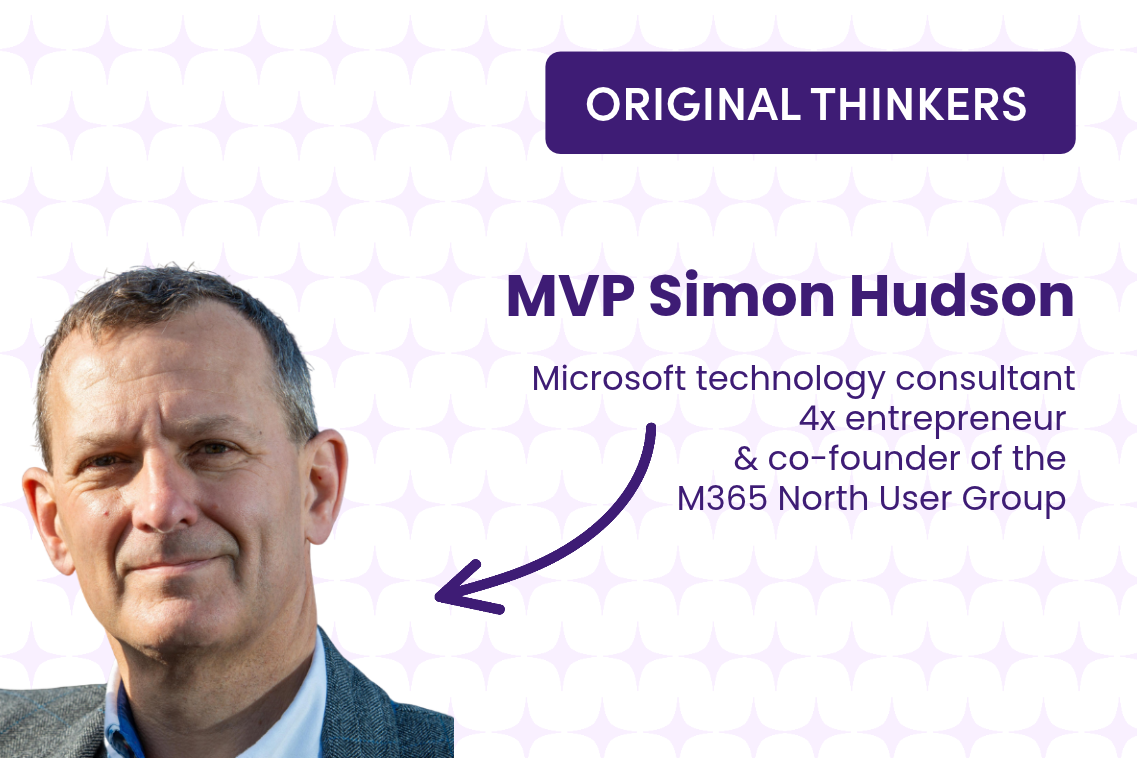
MVP Simon Hudson’s first piece of advice to anyone who wants to become a Microsoft MVP is not to try. You earn it, he says, by doing the work on its own merit, because you’re passionate about it.
The advice holds up. Everyone he has put forward for the award, three people so far, has become an MVP.
Bringing people through has long been the point for him. Fifteen years ago he co-founded the M365 North User Group with Simon Doy, and one of its founding principles was to bring on new speakers, so that when the founders stepped back, others would already be doing the things they believed in.
At the annual CollabDays in Bletchley Park he makes a point of buddying up with relatively new speakers, so they have someone experienced beside them and don’t have to hold the room alone. One of them had never spoken in the UK. Several Bletchleys later, he’s an MVP and recently spoke at several conferences in Sweden, with more in the offing.
That eye for people matters, because the challenge facing Microsoft Partners right now is as much about people as technology. Microsoft wants partners to sell more Copilot licences, drive deeper adoption and take the conversation to the C-suite. Yet many of their customers are nowhere near ready, and others have switched AI on themselves and got stuck.
Simon, who also co-wrote the Customisation and Development Competency of the Microsoft 365 Maturity Model, sees two jobs for partners in that gap.
The first is readiness. AI amplifies whatever an organisation feeds it, so poor governance and messy content get amplified too. Those working in this space, he says, have been warning about it for 20 years, and nobody would listen.
Now they have to.
The second job is closer to what he does at Bletchley: finding technical people and turning them into voices that can persuade a boardroom. He expects AI’s real impact to land around 2030, so partners who want to be ready need to start on both now.
He sat down with Juliet Stott to talk about overcoming staff resistance to Copilot, managing citizen developers, the future of development houses and how to win the C-suite conversation Microsoft wants you to have.
Juliet Stott: Let’s start with adoption. Customers’ employees are often frightened of Copilot and reluctant to use it for fear of losing their jobs. How do partners overcome that?
Simon Hudson: Will AI take jobs? Absolutely it will. Will it change the workplace? Yes, absolutely, as almost every technology before it has. But laying people off, getting rid of jobs, is a human choice, not an AI choice.
Look at IKEA. It introduced AI into its call centre and displaced 2,000 workers without a single redundancy. It retrained them to do other, actually more meaningful, things.
And the genie is out of the bottle.
People say they don’t want to use it because they’re not sure AI is right. Those organisations are in danger of going out of business. It might take a few years, but if you don’t adopt the technology and adapt to it, somebody who grasps it will eat your lunch.
We’ve seen it with Kodak and Blockbuster, which completely dominated their markets. Encyclopaedias no longer exist in any reasonable form. So if a company wants to survive, and not lay people off because it’s going out of business, it has to remain competitive. AI is part of the way you do that.
“Laying people off, getting rid of jobs, is a human choice, not an AI choice.”
Juliet Stott: Microsoft is also marketing straight to customers: turn it on, hand it to your employees and let them build their own agents. The ones that have done that are finding Copilot creates more work. Mistakes are being made, and agents are grounded in poor data or a snapshot of it. What’s going wrong?
Simon Hudson: The issue is really one of readiness. If you accept that adopting AI is necessary to remain competitive, the question becomes whether an organisation is culturally and organisationally ready to take AI on properly.
You’re right that, for now, introducing AI won’t actually lessen the workload. There are mistakes to be fixed, and there’s a massive job in every organisation to sort out the governance and the content cleanliness. We need a seismic shake-up in the way people manage their data, because otherwise organisations can’t use AI effectively.
Eric Shupps, one of the US MVPs, coined a phrase I really like. It used to be garbage in, garbage out. Now it’s garbage in, garbage amplified.
Ultimately, if your expensive Copilot licenses are producing bad results people will rapidly lose faith in the technology. I contend that poor content lifecycle management is now the number one blocker to AI enabled transformation.
Juliet Stott: So the clean-up is work for partners?
Simon Hudson: In the short term, there’s a huge amount of work to do. New roles are being created to sort those problems out, and they’ll soak up roles that would otherwise have been displaced.
There will also be a whole bunch of new roles around AI compliance and AI governance. But once you’ve sorted the chaos in your content, those clean-up roles are no longer needed. And I just don’t think there’ll be as many new AI roles as the roles AI can displace.
AI is able to develop more quickly than human and organisational processes can accommodate. So there’s some inertia in the system. It won’t happen super quickly, because organisations can’t change and adapt in that time, no matter how powerful the AI is.
That inertia will give us a chance to stabilise the system, perhaps.
Juliet Stott: Then there’s shadow AI. Enthusiastic, intelligent people with no grounding in governance spin things up in consumer AI tools and skip the IT ticket, because IT is seen as slow. Then they want their creation rolled out across the tenant. How do you rein them in without stifling the innovation?
Simon Hudson: This is nothing new. The pace is different and the scale is different, but the principle has been around for years.
In my corporate days, the joke was that it didn’t matter what you wanted from IT, it would cost a quarter of a million dollars and take six months. That wasn’t an unreasonable statement, and the consequence was that people spun up their own shadow IT. I was guilty of it. In fact, I was proactive about it, because I could write code and build applications. I tried to work with IT, somewhat successfully, and they’d come to me for help because I could do things in agile ways.
When Simon Doy and I wrote the development competency for the Microsoft 365 Maturity Model, we described a spectrum running from no code and low code all the way through to pro code, people writing C# and all the other scary things.
The low-code end is where you get innovation, rapid solutions, prototyping, proofs of concept and demonstrations of what could happen. Then there should be a process to allow it, oversee it and progress it into being managed, and potentially into a full application.
The better organisations are already allowing some freedom at the low-code, citizen development end. Then, as something becomes more meaningful or impactful in the organisation, they put wrappers around it.
AI accelerates that enormously.
Even pro coders are now vibe coding, taking a citizen developer’s mindset and spinning things up really quickly. The difference is that proper development teams then put rigour around it: documentation, lifecycle management, governance and testing.
Juliet Stott: Some customers go the other way and want tight control, running AI locally so their data never leaves the building. Microsoft is also pitching local AI processing on devices as its answer to the cost of AI. Where does local AI fit, and what should partners be telling customers?
Simon Hudson: This isn’t my area of particular expertise, and I’ve not played with the local models. But some organisations are culturally nervous about sharing content with cloud providers, regardless of the assurances they’re given. Some have very good reasons, the military for example. They need local systems. So there is, and will be, a role for local AI, and as the models and the processing behind them become more efficient, running them locally becomes more realistic.
But right now, if you want absolute top-of-the-game AI, you can’t run it locally. You haven’t got the computing power. The stuff I do will regularly spin up, I don’t know, 30 servers without me even knowing it’s happened. And I remember the days when getting an organisation to put in four servers to run SharePoint was anathema to them.
So where it’s needed, local will be used, cloud services will continue, and it’ll be a continuum from one to the other, because when you need the power, you can’t run your own.
And Microsoft, Anthropic and OpenAI are as keen as anyone to reduce the cost of AI. Not for us, for them. The investment they’re putting into data centres, and the cost of running them, is mind-bogglingly big.
It’s costing them billions.
Economics is a great motivator, so they’ll find ways to pass the processing back to organisations. Instead of generating an image in the cloud a thousand times a day, you offload that to a local AI processor, on your machine or within your infrastructure. Or you do pre-processing locally, so that what you hand over to the big cloud models is already efficient.
We’ll see a lot more of that optimisation, often using different models, going up and down the stack.
Juliet Stott: Microsoft’s big release soon after CollabDays effectively treats apps as individual objects, as easy to spin up as a Word document. What does that do to existing development teams, and to the partners who provide them?
Simon Hudson: They didn’t use those words, but that’s effectively what they’re saying. I think it’s a little bold. But I can see why they’d push it, and they may not be wrong. It means a lot more low-code stuff, which is a lot more worrying. And it rapidly eats into established development teams and development teams for hire.
I’m also seeing the emergence of AI-moderated code factories, where people describe the application they want and have a robust, managed, governed solution presented to them within a day.
That’s a potential disruptor right there.
Right now, though, we have only something like 70% of the developers we need nationally. There’s a real shortage of that skill set, so for the next five years, maybe, AI will just ease that shortfall. We’ll always need some developers, so there’ll always be a route in. Maybe we just won’t need so many of them.
So I’m guessing we’ll see some pivots. AI can generate the code, so you don’t need developers to generate the code. AI might even provide some of the governance oversight and lifecycle management. But organisations will need skills they no longer have, because they got rid of their developers thinking AI was doing it. They’ll need people who can stand up all the processes, agents and skills that will do their development for them, and then manage them.
I think development houses in the future will be brought in to establish the AI development team, monitor it and improve it as the technology moves on. Writing the code won’t be the job. And I think that’s a full-time role.
“Development houses in the future will be brought in to establish the AI development team, monitor it and improve it.”
Juliet Stott: Recently Microsoft told a room of partner owners they now need to talk to the C-suite, prove outcomes and value, and tailor the message to each role. It didn’t say how. And the CIOs partners usually deal with rarely have that boardroom clout. Who should partners send into that conversation?
Simon Hudson: I completely agree that this is a CTO, CIO and CEO conversation, though it’s not entirely new. I was talking about exactly this recently with a colleague from the user group. He’s moved from hardcore technical development into an awful lot of pre-sales work, and he’s joked for a couple of years about being turned to the dark side. Actually, I think that dark side is the light side.
People who have the technical knowledge to have credible conversations and understand the implications and constraints, but who also have the interpersonal skills and charisma to carry the day, are vitally important.
My recommendation to partners is to seek those people out from within your own ranks. Domain knowledge is really important, so find the people who have it and can also become front of house. Those are going to be rockstar roles.
And those are not sales roles. They’re not there to sell. They’re there to persuade, convince and empower their customers. The salespeople can go and sign the contracts. I never really sold a thing in my life. I just persuaded people that things were good, and then they’d ask if they could buy one.
Juliet Stott: How do you prepare a technical person for the boardroom?
Simon Hudson: Train them to speak to executives, because that’s a different art. I learned it the hard way. I came up through a big corporate structure and was invited into boardrooms to tell the exec why I wanted to do something, or to get a beating in a few cases.
Influencing executives inside and outside of meetings means understanding their motivations, their lack of time and their corporate and legal exposure and enabling them to be successful.
It’s a skill people don’t generally get to learn until they become an executive, so we need to teach people to do it. I don’t quite know how to do that. But I coached a couple of people through it in my organisation, because I got to be an exec for a while.
I don’t think AI can do that. It might be able to maintain the coaching once you’ve started, but you’ve got to actually train people, with people.
Juliet Stott: Microsoft Partners are at the leading edge of this technology. How do they capitalise on that?
Simon Hudson: The soundbite position is that you’ve got to embrace it. You’ve got to be looking at the horizon, seeing what the next iteration will do to you as a partner company, as well as to your clients. If you’re not thinking about that, you’ve got a problem, because the world won’t be the same in five years’ time. You need to be on the front foot already, so that somebody else doesn’t make you irrelevant because they’ve already adopted.
So yes, get on with it. Don’t be shy, because that will just lead to your demise. Find the great people in your organisation who understand it and can be front-facing, convincing potential clients about what they need to look like. And listen to the people who’ve got the crazy ideas, in your organisation and outside it, because without the crazy ideas, you won’t evolve your company in time to be future-ready.
I’m looking at 2030 as when we start to feel the real impact of these changes. That’s only around three years away. And it will take an organisation at least a year to change.
So you haven’t got long to decide which direction you’re going to change in.
Simon Hudson is a Microsoft MVP, four-time entrepreneur and co-founder of the M365 North User Group, which he set up with Simon Doy and Paul Gallagher 15 years ago. He speaks at CollabDay Bletchley Park, where he mentors first-time speakers, and co-wrote the Customization and Development, AI and Cognitive Business, Communication and many other competencies in competency of the Microsoft 365 Maturity Model. He also lectures in business studies at the University of Hull. Find him on LinkedIn.


