Copilot. Agents. AI Models. Sovereign cloud.
There was plenty to talk about at Microsoft AI Tour in London this week. But beneath all of it ran a single theme.
People weren’t asking what can it do? They were asking: where is it working?
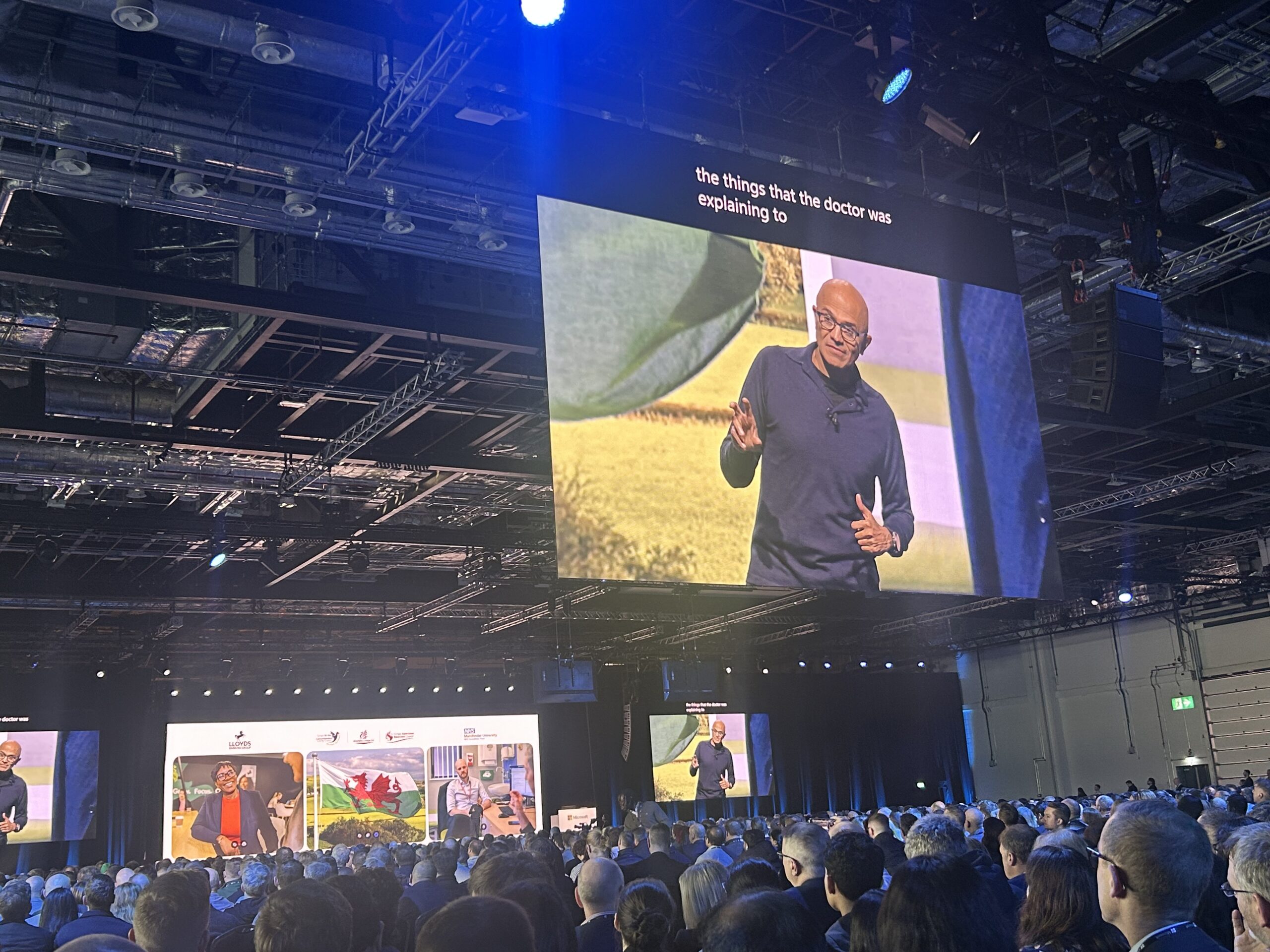
And when Satya Nadella stepped onto the keynote stage, he didn’t open with benchmarks or competitive claims. He skipped straight to outcomes.
“When you think about any technology that’s being applied, you want to make sure that your ability to deliver the proper service is getting better. That the experience for your own employees is now far superior than it was before. Your internal operations are getting more efficient. These real-world outcomes are what we really want.”
And to make that argument land, he returned to it again and again — not with slides, but with case studies.
Lloyds Banking Group: credibility through scale
Nadella referenced Lloyds Banking Group. A 250-year-old institution. Deeply regulated. Operationally complex. And now one of the largest enterprise Copilot deployments in the UK.
The message was deliberate. If Copilot is operating at scale inside Lloyds, the conversation shifts — from experimentation to execution.
Manchester University NHS Foundation Trust: impact you can see
Then came Manchester University NHS Foundation Trust. Clinicians piloting Microsoft’s Dragon Copilot — an AI assistant that listens to consultations and generates structured clinical documentation in real time. Less time typing. Fewer system switches. More focus on the patient in front of them.
Early indications suggest the technology could eventually enable the Trust to see and treat up to 250,000 additional patients annually.
In healthcare, that number doesn’t read as a productivity gain. It reads as access.
The example that hit closest to home
And then, almost in passing, a smaller story. A childcare provider. Regulatory reporting that used to take four days. Now takes one.
In reality, most organisations in that room weren’t global banks or NHS Trusts. They were mid-sized businesses navigating compliance, admin and growth simultaneously. For them, the question wasn’t whether AI is powerful. It was whether it’s practical.
That example answered it.
On the exhibition floor: the same pattern, repeated
Walking the exhibition floor Microsoft had invested heavily in industry-specific stands — aerospace, financial services, healthcare, sport — each grounded in use cases rather than feature lists.
And the casual conversations I had with delegates I met told the same story. Not one person was wondering about capabilities. They were wanting to know: who’s doing this, and how are they making it work?
The appetite for Copilot is there. But the appetite is for evidence.
Your buyers left that room asking the same question
Here’s the implication for Microsoft Partners: the scepticism in that room wasn’t just an event-day feeling. It’s how your prospects are approaching every conversation about AI right now.
They’ve sat through the AI briefings. They’ve read the Gartner reports. They’ve heard from five other vendors this quarter. What they haven’t heard enough of — from you or anyone else — is a story that sounds like their own situation.
That’s what a well-crafted case study does. It doesn’t explain what the technology is capable of. It mirrors the buyer’s reality back at them: a recognisable problem, a specific change in how work gets done, a result they can take to a board meeting. Done properly, it gives your internal champions the language they need to make the case upstairs — before a salesperson is even in the room.
Capability decks can’t close deals on their own. Evidence can.
The case study structure Nadella used on stage — and you should use too
There was nothing complicated about how Nadella structured the stories he shared.
Start with the problem — specific enough that someone with the same challenge recognises it immediately. Describe what actually changed: the workflow, the process, the day-to-day reality, not what the technology is theoretically capable of. Then anchor it in a concrete outcome.
Four days to one. 250,000 additional patients. Lloyds at scale.
Add a senior quote from the client — not praising the product, but describing what changed for the business. Close with a clear next step.
That structure works across your website, your sales deck, your LinkedIn outreach, and your email sequences. One story. Many surfaces. And — crucially — a shelf life measured in years, not campaigns.
Now for the part most Partners leave on the table
If you’re a Microsoft Partner earning Co-op funds, you’ll already have budget allocated to create exactly this kind of content.
Co-op isn’t a grant — it’s value you’ve generated through your Microsoft relationship, made available under conditions for eligible activity. Case studies built to promote Microsoft solutions and drive demand sit squarely in scope.
What makes this particularly worth paying attention to: Co-op is time-bound. The content you build with it isn’t.
PPC stops the moment you stop paying. A well-written customer story keeps working — ranking in search, arming your sales team, giving prospects the confidence to move forward — long after the campaign that funded it has expired.
Co-op deadlines create urgency. Yet a case study built this half can still be opening doors two years from now, while the PPC campaign you ran instead will be long forgotten.
Three case studies. One room. One clear message.
In a year where AI dominates every headline, the most persuasive moment at Microsoft AI Tour London wasn’t a product launch or a capability roadmap. It was CEO leading anchoring his keynote with three stories about a bank, a hospital, and a childcare provider.
Your buyers are in the same room, asking the same question. Give them the proof they need — and give yourself a piece of content that keeps earning long after the event.
If you’re a Microsoft Partner with Co-op funds to use this half, get in touch. We’ll help you turn your funds into high performing case studies that drive awareness and increase your leads.
Read other articles by Juliet Stott and connect with her on LinkedIn


